Podgorica, Montenegro – the ‘Most Boring’ European Capital?
We like to rate, label and rank travel destinations into various lists. The Most Picturesque City. The Friendliest Capitals. Top 10 Most Affordable Places. Poor Podgorica often wins the inglorious title of “the most boring capital in Europe”. But is it really?
Well, kind of yes. Sorry, but the Montenegrin capital pales in comparison to other (even smaller) cities in the region. That doesn’t mean you should avoid it, though. I had a good time when I first visited in October 2025, and would encourage you to include it in your Western Balkans itinerary.
Read on for recommendations on what to see in Podgorica.

Train from the airport
If you’re coming to Podgorica by plane, you might hear that taxis are your only way to get to the city. That isn’t true. I saw buses outside the terminal, but what I suggest is that you take a train!
The Aerodrom train station is about a 15-minute walk down the main road from the airport, and then a parallel pedestrian path. Don’t be scared when you see the actual “station”. True, the shabby concrete shelter has seen better days, but the area is safe, even though it looks a bit sketchy. For trains towards the city you need to cross the tracks to the other platform. Yes, it’s OK to jaywalk! 🙂

Trains only run every 2 to 3 hours and I understand that they might not synchronize with your arrival. But riding one is a rare activity in Western Balkans where the rail network isn’t elaborate. The ride itself is about 7 minutes and only costs just over 1 euro!

Millennium Bridge
One of Podgorica’s newest landmarks, yet also one of its most recognizable. The stunning cable-stayed bridge over the Morača river opened on 13 July 2005, Montenegro’s National Day. The best view of Most Milenijum is from the Gazela Bridge to the south. With the green riverbanks on the sides and dramatic mountains in the distance, the scene is nothing but postcard-ready. For best effect, wait until the sky is clear, so that the cables don’t blend into the clouds.


Gazela Bridge
This narrow pedestrian-only bridge gets overshadowed by its more impressive neighbours, but don’t ignore it. Actually, bridge-hopping might turn out a fun activity in Podgorica!
Walking down Most Gazela you’ll feel slight vibrations – this is due to its wind-resistant design. Running along its whole length is a lyric from the song “Podgorica” written by Zlatko Jovović and recorded by Sergej Ćetković, Pero Stefanović, Edo Abdović and Igor Perazić in the early noughties. The words were painted by art group Kunstler in 2020.

Old Bridge
OK, this is the last bridge, I promise! 😄 But the most beautiful one, that’s for sure! And the oldest one in the city, dating back to the Roman times, hence the name Old Bridge (Stari Most). Some people call it after Adži-paša Osmanagić, a wealthy merchant who funded its reconstruction in the 18th century.
The bridge straddles the Ribnica river (Morača’s tributary) and looks most stunning when the tide is high. On my visit the river was a bit dry, but that didn’t diminish the overall beauty.

It’s a very picturesque (and my favourite) part of the city, with fortress ruins on the southern bank and lots of greenery everywhere. At times you feel like you’re far away in a peaceful woodland, not in the centre of a capital city.

Stara Varoš
The Old Bridge is only a few minutes’ walk from Stara Varoš – the “Old Town”. It’s the oldest part of the city, dating back to the Ottoman era, and for centuries it was the heart of Podgorica. Unfortunately, most of it perished during the World War II bombings.
One of the very few surviving structures is the Clock Tower (Sahat Kula), built in 1667, again thanks to Adži-paša Osmanagić. The 19-metre stone tower has not only survived the war, but also earthquakes, and today is one of the most important landmarks in Podgorica.

Independence Square
To the north from Stara Varoš is Nova Varoš – yes, you guessed it – the “New Town”. Instead of narrow winding streets, this part’s layout is an orderly rectangular grid. Some of the streets are pedestrianised, and many host cafés, restaurants and small clothing shops.
The centre of Nova Varoš is Independence Square (Trg Nezavisnosti), once known as Republic Square. In 2006, it was widened and decorated with a fountain, palm trees and colonnades. It’s where major national celebrations and open-air festivals take place.

Parliament of Montenegro
Between Independence Square and Blažo Jovanović Bridge is what you could call Montenegro’s government quarter. Its modest scale is understandable as the country declared its independence only in 2006. Still, it’s worth to take a quick look at the parliament building and the L‑shaped Ministry of Foreign Affairs next to it.

Blok 5
I understand if you’re puzzled to see a residential housing complex on this list. But it’s a must-see for the lovers of brutalist architecture.
Blok 5 was built between 1977 and 1984 in what was then the city’s western outskirts. Architects Vukota Tupa Vukotić and Mileta Bojović designed the blocks so that they appear to be moving, with “breathing space” between them filled with greenery, playgrounds and sufficient parking space. It was an innovative project, rejecting the standards followed in Yugoslavia at the time. The high-rises offered anything from small studios to 4‑bedroom apartments.

Unfortunately, Blok 5 seems to have its glory days behind it. Today, some blocks are rather derelict, with crumbling exteriors and graffiti here and there. The playgrounds are slightly drab, and the abandoned shopping centre Fenix gives off forbidding energy.
And yet I enjoyed my quick walk around the estate, soaking in the atmosphere and imagining what it would be like to live in one of these apartments.
 This phoenix won’t be rising from ashes anytime soon…
Church of the Sacred Heart of Jesus
Another example of brutalism is the Church of the Sacred (or Holy) Heart of Jesus, in the Montenegrin language known as Crkva Presvetog Srca Isusovog. It opened in the late 60s, replacing another Catholic church that fell casualty of the WWII bombings. The new, very austere building was designed by Croatian architect Zvonimir Vrkljan and was meant to resemble …a ship. The limited daylight comes in only through a handful of windows on the sides and the tower above the altar (the ship’s mast?), which creates a gloomy interior. It looks really cool, unlike any church I’ve seen so far, and I regret not coming inside. You’ll find it in the Konik neighbourhood, not far from the train station.
 Spot a group of kids waving at me from the entrance 😀
Cathedral of the Resurrection of Christ
Orthodox Christianity is the main religion in Montenegro, amounting to over 70% among the population. This cathedral, known locally as Saborni Hram Hristovog Vaskrsenja, was two decades in the making before its consecration in 2013. The impressive structure is made of white stone blocks, rough at the bottom, but gradually smoother towards the top. While praised for its “charmingly eccentric” design, the cathedral also drew criticism for political commentary. Observant visitors will spot a fresco of former Communist Yugoslav leader Josip Broz Tito, Karl Marx and Friedrich Engels all burning in the fires of hell.

I didn’t have a chance to check out the interior as a wedding was taking place there, but I think it’s one of the most beautiful buildings in the city.
Statues
There are many nice statues in Podgorica. Fortunately, not as many as in Skopje! 😃 The most popular one is the quirky memorial for the Soviet singer-songwriter Vladimir Vysotsky, known for his love for Montenegro. He’s presented in a dramatic pose, shirtless, holding a guitar, with a skull below his feet. Fittingly, the statue is right next to the Moscow Bridge.

Outside the Museum of Contemporary Art, there’s a monument to Alexander Pushkin and Natalia Goncharova. King’s Park has a statue of Montenegro’s last monarch, King Nikola I, pictured majestically on a horse. And in Njegošev Park, you’ll find poet and philosopher Petar II Petrović-Njegoš sitting across the road from the Montenegrin National Theatre.

Murals
Podgorica is far from being a street art hub, but you’re likely to spot a nice mural here and there. Like the striking kids portrait painted in support of Palestine by Mišo Joskić. The artist wanted to draw attention to human suffering and show solidarity with Palestinians. The striking mural was unveiled with much hype in September 2024. You’ll see it as soon as you step out of the train or bus station, right across the street.

Later on, I spotted another one by Mišo, made in collaboration with Pavel Brat and based on a drawing by Srđa Dragović. It was painted in 2017 for Biciklo, a local organisation advocating for cycling and sustainable transport. It’s on the apartment block I was staying in, near the park on Bulevar Pera Ćetkovića. I enjoyed looking at it every time I was coming back from a local supermarket.

Final reflection
So, what do you think? Not too bad for the “most boring European capital”, right? And I realize that I still missed a few things, such as Petrović Royal Palace. There are also some brutalist buildings I didn’t get to see, and a decent café scene that I somehow overlooked. So, a second trip to Podgorica is due at some point, and I’d encourage you to give this city a chance, too!
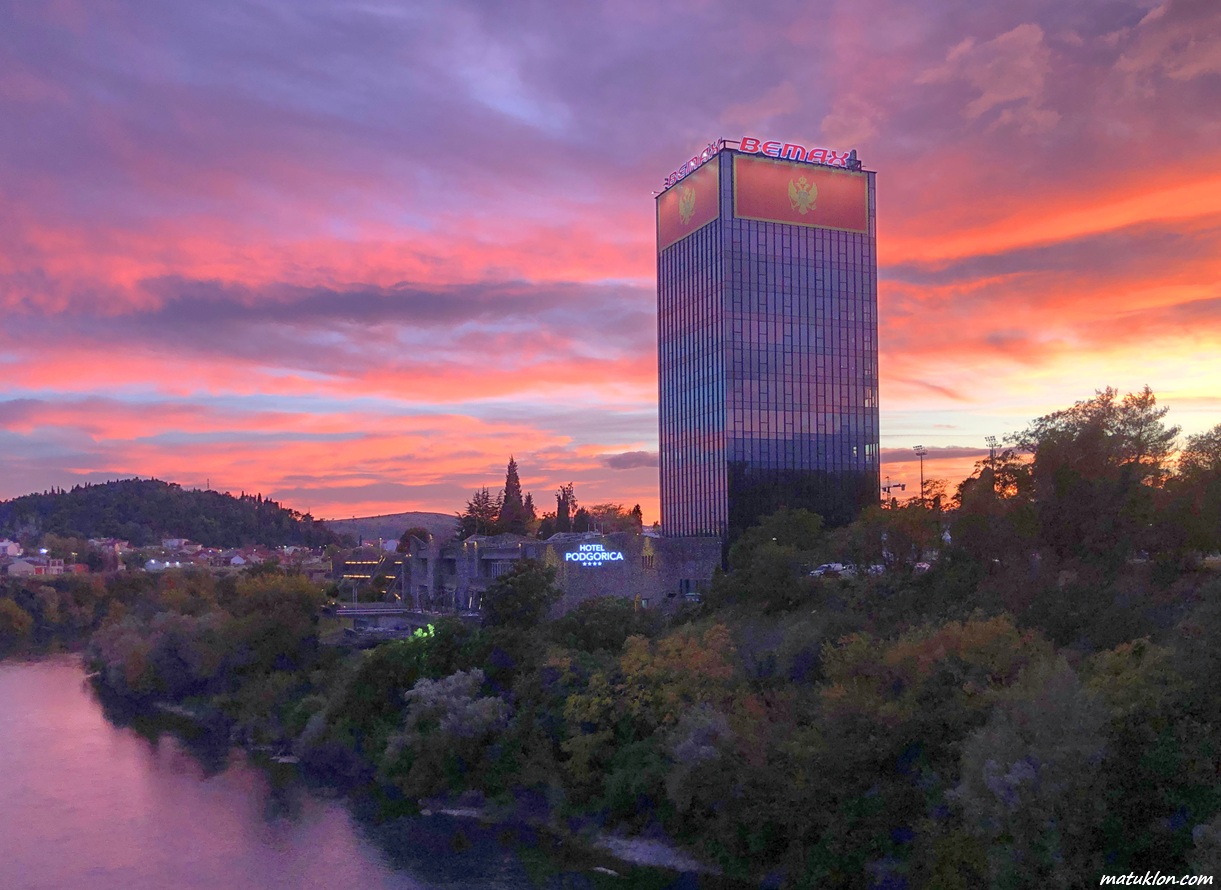
 On my last evening in Podgorica I was treated to one of the most wonderful sunsets I’ve ever seen… #nofilter
Sources
Na mostu ispisani stihovi “nezvanične himne Podgorice”. Vijesti Online
Be Realistic – Demand the Impossible! Podgorica’s Blok 5. Lefteast
A New Cathedral for Montenegro – Thoughts on the Architecture. Orthodox Arts Journal
Montenegro church depicts Tito, Marx and Engels in hell. BBC News
U Podgorici svečano otkriven mural posvećen Palestini. Vijesti Online
15 Cool Things to Do in Podgorica, Montenegro. MyWanderlust
