3 Days in Tunisia: Tunis and Beyond
Most people reduce Tunis to a quick entry into Tunisia before moving on to tourist hotspots. But the capital city has a lot to offer and deserves more love. Having only 3 days to play with, I decided to focus on just Tunis, but still managed to squeeze in a (somewhat rushed) day trip.
Read on for places to see in Tunisia, main tourist attractions and recommendations.
Clock Tower
The bus from the airport will drop you off not too far from Place du 14 Janvier 2011, named in honour of the Tunisian revolution. It is the very centre of the city and a popular meeting spot. In the middle stands the Clock Tower, erected in 2001 by dictator Zine El Abidine Ben Ali (hence the nickname ‘Big Ben Ali’). The obelisk replaced the old clock which rested on columns joined by an arch.
Although relatively new, the tower is one of the most recognizable landmarks in Tunis. The fountain next to it adds extra charm, and the whole scene is enclosed by a busy roundabout.

Avenue Habib Bourguiba
From the Clock Tower, take a walk down Avenue Habib Bourguiba, the main drag of the city. It was named after the first President of Tunisia – and there he is, immortalized as a statue, sat on a horse.

The avenue is lined with hotels, shops, travel agencies, banks and cafés. It’s also home to Tunisia’s Ministry of Interior, French Embassy, Cathedral of Saint Vincent de Paul, and the Municipal Theatre. The wide median strip is pedestrianised and lined with tress, ending with a photo opportunity at the I Love Tunis sign.


The banks were handy for getting Tunisian currency, and I must say that the exchange rates were surprisingly good for such a central location!
Passing by one cosy café after another, I was tempted to come back for a cold drink, but sadly never did. One of them was called Champs-Élysées, and you’d be forgiven for thinking you’re in the French capital. The avenue was clearly modelled on the iconic Parisian thoroughfare. Very fittingly, it extends into Avenue de France, which itself ends with Bab el Bhar (Porte de France) – Tunisia’s own Arc de Triomphe?
Tunis Medina
Bab el Bhar is one of two surviving city gates, and the best place of entry into the Medina of Tunis. The “old town” was founded in 698, and since 1979, holds the UNESCO World Heritage Site status.
Like in other Arabic cities, the medina invites a relaxed stroll through the narrow, winding streets, or even letting yourself get lost in its maze-like structure. There are about 700 monuments, so keep an eye out on various palaces, mosques and madrasas (schools). And the countless colourful doors! Medina has some charming cafés and restaurants, and it’s also the best place to get your souvenirs.


Zitouna Mosque
In the centre of the medina stands the grand Zitouna (Al-Zaytuna) Mosque, its minaret towering above this part of town. Not only is it the biggest mosque in Tunis, but in the whole of Tunisia! Over the centuries, it has developed into a place of higher education, and today is one of the oldest universities in continuous operation …in the world!

Café Panorama
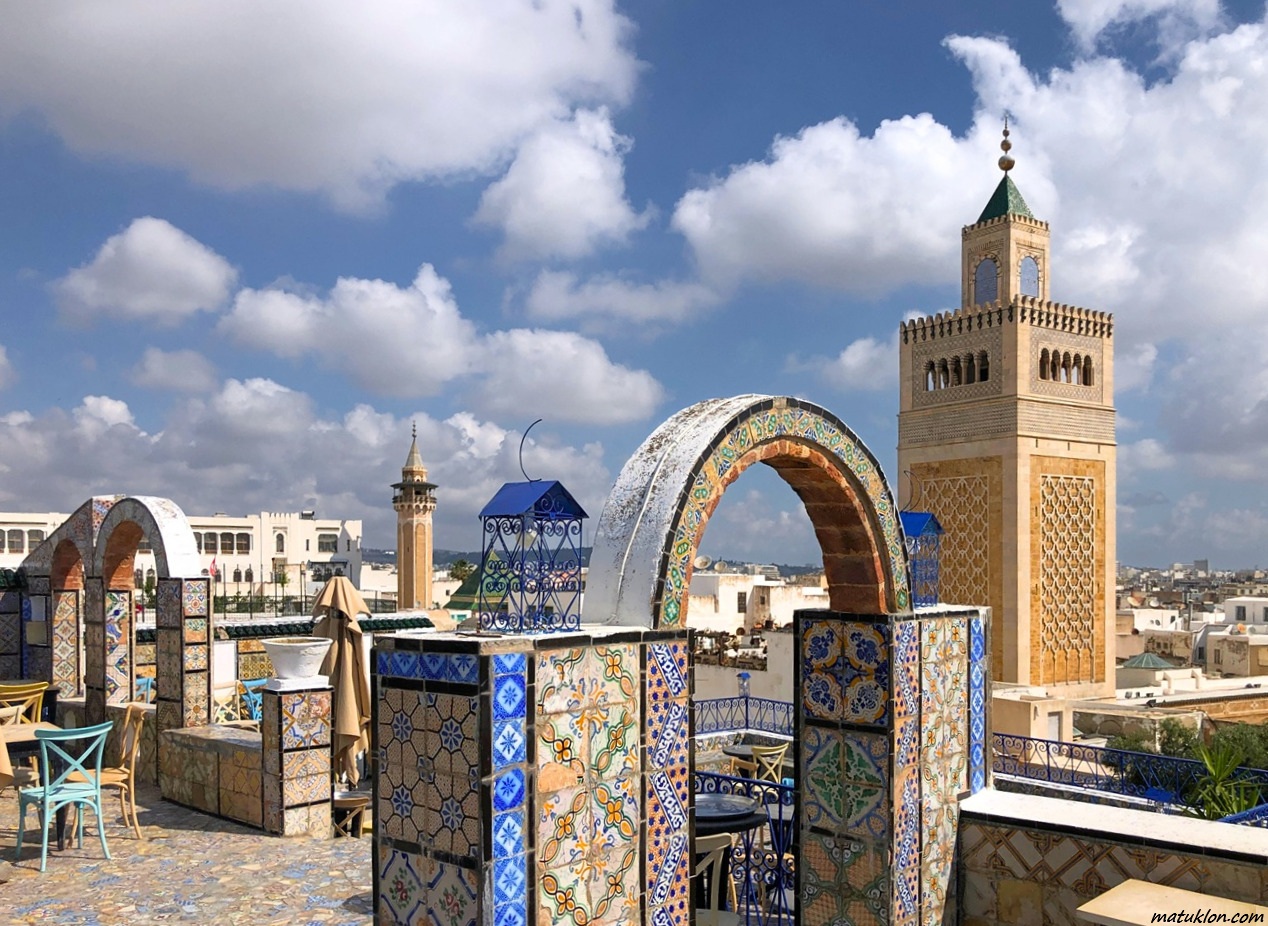
For the best view of the minaret (and the surrounding area, in fact) go to Café Panorama. It’s not that easy to find it in the maze of the medina: you need to enter through carpet shop Maison d’Orient and then take the stairs on the left. The aptly named rooftop café offers wonderful panoramic views and a picture-worthy décor, featuring colourful furniture and tiles with intricate patterns. It’s a hip hangout spot and a tourist attraction in its own right.
…and, sadly, a tourist TRAP at the same time. Expect getting charged a ridiculous amount for a VERY average espresso, without being allowed to see the menú first. Even the view can’t make up for the sour feeling of being scammed.

Kasbah Square
Heading westward from the medina, you’ll walk onto Kasbah Square. It houses the City Hall, Ministry of Defence, National Archives and other high-profile institutions. The centrepiece of the spacious square is the National Monument, made in the late 80s by Abdelfattah Boussetta. The concrete structure caught my eye immediately, giving me brutalist vibes. It reminds me of something you’d see in the far Eastern Europe or Central Asia. Really cool.

Avenue Mohammed V
Another important street in Tunis, named after a Moroccan king, running north from Place du 14 Janvier 2011. Walking down the wide, elegant avenue, it’s hard to believe that only in the 1950s, it was nothing but a muddy slum! Today it’s an address of the utmost prestige and home to major banks, expensive hotels and government buildings.

City of Culture
On the eastern side of Avenue Mohammed V there’s City of Culture (Cité de la Culture), encompassing 9 hectares. 15 years in the making, it opened in 2018, and later was named after politician Chedli Klibi. As the name suggests, the complex houses a number of cultural institutions, such as the Opera Theatre and the National Museum of Modern and Contemporary Art.
Although described by former Minster of Culture Azedine Beschaouch as “Stalinist” and “aesthetically boring”, I actually really like it, but I agree that it has a touch of Soviet style to it. Particularly striking is the tower, with the huge glass sphere suspended between the four 60-metre columns.

Hôtel du Lac
Believe it or not, but this was one of the things I was most excited about in Tunis! If you’re a fellow lover of brutalist architecture, you’ll understand. It just makes me sad that by the time you’re reading this, it most likely isn’t around anymore…

The “Lake Hotel” was designed by Italian architect Raffaele Contigiani and built in the early 70s. Its absolutely iconic shape of an inverted pyramid has even inspired the sandcrawler vehicle in Star Wars. In the 90s, though, it fell into disrepair and ultimately closed in 2000. Demolition threats kept coming and going, always sparking public outcries – yet the inevitable happened…
I was very lucky to catch one of the last opportunities to admire the building in person when I visited in April 2025. Little did I know that just four months later, they would start tearing down its top floor…


Other places
As I said, there’s so much to see in Tunis! Here are some highly recommended places that I didn’t get to visit:
● Kasbah Fortress
● Grand Synagogue
● Belvedere Park and Zoo
● Tunisia Mall – the biggest shopping centre in the country, with a wide variety of shops and restaurants
● Bardo Museum – art and history museum, technically outside Tunis, but often listed as the number 1 attraction, surely worth a day trip
 Grand Synagogue of Tunis
Carthage
Speaking of day trips – if you’re coming to Tunisia, I’m sure you already have this one in your itinerary.
The ancient city of Carthage was one of the most important trading places of its time. Today, its ruins (some of them dating back to the 1st century BC) are Tunisia’s biggest tourist magnet.
The ticket costs only 12 dinars and grants access to all archaeological sites. Keep in mind that they’re sprawled over a large area and close at 5 pm for most of the year. I headed out quite late in the day and managed to see only 3 out of the 10 sites. Not a good use of the entry ticket, I know… I blame my flakiness on the heat fatigue.
I started my exploration with the Baths of Antoninus – one of the biggest Roman baths in the Empire times. Originally, they were multi-storey buildings, with numerous high-capacity hot and cold rooms. What’s left of them today are the foundations and some of the lower floors, but it’s not hard to imagine how grand they were in their heyday.

Some sections, like the Punic cemetery, are more secluded and overgrown by gardens. But the main bath ruins are beautifully set against a sea backdrop, making them one of the most impressive and popular Carthage attractions.

It was already mid-afternoon, so I quickly made my way to the Carthage Amphitheatre, before moving on to Byrsa Hill. Visiting the National Museum wasn’t an option, but it was closed for renovation anyway (and over a year later, still is). There was no time for anything but taking a quick look at the Punic Quarter below and admiring a panoramic view of Carthage with the Gulf of Tunis stretching behind it. We were now nearing the closing hour, but managed to snap some photos before the guards rushed us out.
 Carthage Amphitheatre
 Byrsa Hill
Sidi Bou Saïd
A few stops after Carthage on the same train line is Sidi Bou Saïd. The small town of just under 5,000 people is often said to be the most beautiful in all of Tunisia. And it’s hard to disagree, looking at the charming cobbled streets and picturesque houses painted in white and blue. Not to mention the cliffside location which offers some unreal views of the Mediterranean Sea!


Painters Paul Klee, August Macke and Louis Moilliet travelled to Sidi Bou Saïd in 1914 and their trip is now part of art history. Today, the instagrammable village is no less of an artist magnet. It didn’t surprise me at all to see a professional photoshoot in the middle of the street.

Sidi Bou Saïd is one of the most visited spots in Tunisia, even though it lacks historical sites and tourist attractions as such. The whole allure is its atmosphere which you should soak in by simply wandering around at your own pace. There are many cafés and restaurants to stop by. The finale of my visit was watching the sunset on the Art Café rooftop terrace with some newly made friends.

We then had dinner in La Goulette, so if you’re interested which local dishes I tried as a vegetarian, click here. And I’d appreciate a comment, even a mean one! 😝

The description of Tunis highlights the enduring power of physical landmarks. It’s fascinating how cultural centers, like Avenue Habib Bourguiba, maintain their vibrancy. This parallels the industry need for secure, reliable digital experiences, much like the robust infrastructure required for a platform such as jljl55 play online casino. Great read!