Casablanca – My Favourite City in Morocco
Before my visit, the name “Casablanca” brought to mind mostly the classic Hollywood film and the record label spawning disco hits in the 70s. I only knew that it is the biggest city in Morocco and the country’s economic centre.
And even though some people (including one local) warned me that it’s run-down and unsafe, Casablanca ended up becoming my favourite Moroccan city. Despite the stressful incident that I’m talking about in a separate post.
Read on about what I got up to during my 3‑day stop in Casablanca. Maybe it’ll inspire you to give it a go?

Old Medina
I couldn’t decide where to stay in Casablanca, but eventually picked the Old Medina as my base. Although not as famous and big as the one in Marrakesh, I found it harder to navigate, which actually added to the charm. It has a bit of a bad reputation, and to be frank, its rough northern part with dilapidated buildings made for a sad view. But elsewhere, many of the winding residential streets are somewhat atmospheric and worth a curious wander.

Most vendors are in the Medina’s southern part, near Avenue des FAR (Forces Armées Royales). You’ll find shops with souvenirs, clothes, everyday bits and bobs, and stalls selling fruits and vegetables. I found the souvenir prices here ever so slightly higher than in Marrakesh.
The Medina was where I attempted to haggle for the first and only time in Morocco. The seller was unbelievably stern and wouldn’t play the haggling game at all. Taken aback, I still bought that copper bell, even though I found it rather pricey. It was for my Dad who collects them.

Quartier Habous
If the chaotic charm of the Old Medina isn’t your thing, head South-East to Quartier Habous (also spelled Habbous or Hubous), known as the “New Medina”. It dates back to the 1920s, when it was meant to replace the old one. And even though the Royal Palace stands nearby, the area never became the heart of the city. Still, many travellers seem to favour it for its more organized, contemporary character.
I didn’t get to see the best of the New Medina. I went there only once, in the evening, when there wasn’t much going on anymore. Or maybe I just didn’t go to the right place? But the area is picturesque and no doubt a must-see.

Not everyone knows that part of Quartier Habous once was the red light district of Casablanca, known as Bousbir. The walled-off, heavily guarded area accommodated several hundred prostitutes in brothels, serving over a thousand visitors …a day! After three decades of sexual debauchery, Bousbir was permanently closed in the mid-1950s and repurposed as a residential area.

Parks
The Arab League Park is probably the most popular green space in the whole city. After a few years of a costly (100 million MAD) and much-delayed renovation, it finally reopened in May 2021. I don’t know what it looked like before, but I feel that the vibrant yet calming space it is today was worth the wait.
I went for a stroll there one afternoon, taking a break from work. The hottest time of the day – not the best timing, but I was sipping on a cool fruit juice from café Jus Corsica round the corner. The expansive trees on both sides of the path made you feel like you’re in a green tunnel. Local youths were lounging around in shaded spots.

I was impressed by the wide, straight alleyways, clean lawns and manicured bushes. And I loved the mirror maze, perfect to appease your inner child! Parallel to the orderly rows of tall palm trees are water features with fountains. Here and there, flamingo-like birds were stalking around the water, but too elusive to be taken photos of…

On my way to the New Medina, I stumbled upon Murdokh Park. Or Parc Murdoch. Or actually, Isesco Park, as it’s officially known since 2006. Even though it says ‘Issesco’ at the entrance… (All those different names and spelling variants in Morocco can be confusing.)
This park is smaller, more dense, and surrounded by quiet residential areas, but still bustling with activity. When I visited in early evening, there were lots of groups, couples and singles strolling around, kids having fun in the playground, and joggers running in loops.

Squares
Mohammed V Square is named after the former king, but colloquially known as Pigeons’ Square. Guess why!
It’s surrounded by high-profile buildings: City Hall, Wilaya – local government office, French Consulate. There is a WeCasablanca sign, designed for picture taking, but in all honesty, it looks worn out and blends too much into the park behind it.
For a much more effective photo, walk 10 minutes up the street (or ride the tram for one stop) to the United Nations Square. You’ll get the WeCasablanca sign against a much cleaner background, with the dome sculpture Coupole Zevaco and the replica of a historic clock tower.

The UN Square is surrounded by shops, restaurants, banks and hotels. The Old Medina is a few steps away, and round the corner, there are international fast food chains …that shan’t be named. There’s always something going on. On the last evening, I walked past a political protest on my way for dinner.
I’m not sure if locals would agree, but at least from my perspective, the UN Square feels like the heart of Casablanca.

Religious sites
Walking to the New Medina, I stumbled upon Church of Notre Dame of Lourdes. It was only built in the mid-50s and like many modern Catholic churches, it’s modest in design. It looks somewhat out of place by the busy roundabout of Place de l’Europe. I’m not interested in churches, but when I’m back in Casablanca, I’ll make sure to go inside and check out Gabriel Loire’s stained glass artworks.

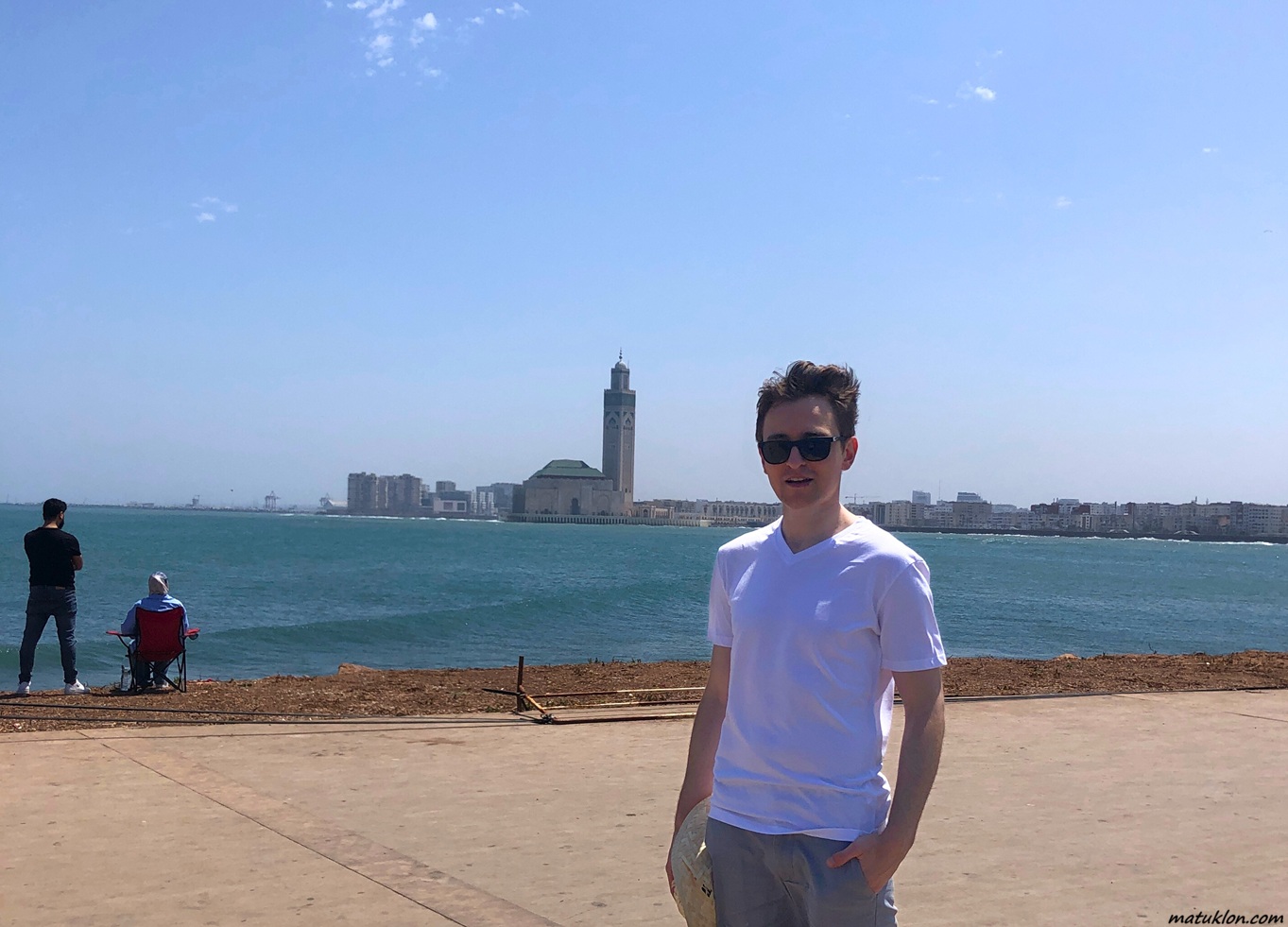
Hassan II Mosque is a fairly new (1993) but already iconic building. It’s the second largest mosque in Africa, and the second tallest minaret …in the world! (Both times beaten by Algeria’s Djamaa el Djazaïr.) Its capacity rises from 25,000 to well over 100,000 worshipers if we include the massive outdoor space in front of it.
It looks stunning at sunset and when it lights up after dusk, but I liked it even more in the daytime. Set against dramatic waves of the Atlantic and the blue open sky, the mosque makes for a picturesque postcard view of Casablanca.

Rick’s Café
You may be wondering if that mythic film locale actually exists – or was it just a product of the screenwriter’s imagination? Well, the truth is somewhere in between.
In 2004, American diplomat Kathy Kriger brought this fictional spot into existence. Rick’s Café is meant to take you back in time – and straight into the set of Casablanca. The elegant décor is a faithful nod to the film, with its sculpted bar, balustrades, arches and lighting. There’s even an authentic 1930s piano, and you’ll surely hear “As Time Goes By” several times a night.
Located near the port area, Rick’s Café attracts crowds of tourists and film buffs. And a wealthy clientele! This high-end spot demands a smarter outfit, and no way would my shorts, flip-flops and a battered straw hat have cut it! So, I walked away, promising myself to come back one day.

Oceanfront
If you asked me what makes Casablanca my favourite city in Morocco, I wouldn’t know what to answer. But maybe it’s the proximity of the ocean? (Which could also be why Mumbai is my favourite Indian city.)
My last full day in Casablanca was about checking out its famous promenade. I started from the Hassan II Mosque and walked eastwards, keeping my eyes on the strong waves – and my hand firmly on my hat!

Casablanca’s waterfront, known as La Corniche, stretches for about 8 kilometres. It’s lined with high-end coastal hotels, beach clubs, and restaurants with spectacular views of the Atlantic Ocean. A popular attraction is the El Hank Lighthouse. I didn’t go in, but next time, wouldn’t mind climbing the 256 steps of the spiral stairwell to the viewing platform.
 Lalla Meryem Beach
After two hours, I finally reached the Aïn Diab Beach, quite likely the most famous one in the city. Some young boys on horses and camels tried to sell me a ride. When I declined, they wanted to “charge” me for taking photos of the beach. Haha, nice try!
I took my shoes off and waded knee-deep in the ocean. Water isn’t my element, and it may shock you to hear that I’ve been to a beach only about a dozen times in my life! I’m just not much of a beach person… But thanks to that, the novelty of walking with bare feet on warm sand hasn’t worn off for me yet.
My initial plan was quite ambitious as I intended to walk as far as Morocco Mall. It’s reportedly the largest shopping centre in Africa, and for that reason alone I was interested in checking it out. But the heat fatigue is real for someone like me, so I decided to cut my walk short. I hopped on a tram, enjoying the comfort of the air-conditioned machine as it raced efficiently through sleepy residential neighbourhoods. It wasn’t long before I was back in the hustle and bustle of the UN Square.

Murals
On my first walk in the city, I was struck by the playful, if a bit creepy, painting Tajine Euphoria by an artist called Normal. Elsewhere, a portrait triptych by Youness Amriss caught my eye. And walking along the promenade, I admired Kato’s Flight and Respect and Ed Oner’s tributes to football legends.
Casablanca slowly revealed itself as a low-key street art hub! I didn’t see it coming, but was all there for it. Now that I’m thinking about it, it surely adds to what makes Casablanca my favourite city in Morocco.
I know that if (or when!) I visit Casablanca again, I’ll spend a day mural-spotting around town.
 Murals by Ed Oner (left) and Okuda (right)
Clinique du-Parc
No way will you find this on any Casablanca tourism list, but it ranked pretty high on my agenda.
French gynecologist Georges Burou opened Clinique du-Parc in the 1950s, and went on to earn fame for supporting trans women in their sex reassignment journeys. Patients included model April Ashley and cabaret star Coccinelle. By the 1970s, he had helped over 3,000 transgender patients, and would operate at the clinic until his death in 1987.
The clinic was on Rue Lapébie, today’s Rue Melouiya, a stone’s throw from the Arab League Park – hence the name. In 2005, Xerox distributor X Office Systems took over the premises, but has recently moved out. Today it looks like a residential building, and passers-by most likely don’t realize its importance for the LGBT+ history.

Practical information
Getting there: Casablanca’s Mohammed V Airport is very well connected, mostly with Western Europe, Western Africa and the Middle East. You can also get there very easily by train from Marrakesh and Tangier.
 Casa Voyageurs train station
Weather: Thanks to the coastal location, Casablanca enjoys a pleasant weather all year round. Even in the hottest time, July–September, the average day temperature is only about 26 °C (79 °F). The winter time of December–February offers a generous 18 °C (64 °F).
Languages: Arabic (namely its Moroccan dialect known as Darija) and Amazigh (Berber) are the official languages of Morocco. French is widely used and often becomes the default language in areas like business and tourism. Many people speak English and some also know Spanish.

Money: The local currency is Moroccan dirham (MAD). While tourist establishments in Casablanca and other big cities take euros or dollars, the exchange rate won’t be in your favour. Cards are accepted at many hotels, shops and restaurants, but in general, Morocco is a cash-leaning country. You’ll need to carry notes with you, especially if you’re looking to shop at markets.

