Cremona, Italy: What to See in the ‘Violin City’
Italy has such a wealth of tourist hotspots that many interesting places inevitably get overlooked. I haven’t heard of Cremona until recently, and only because I was going there to see a concert of Patty Pravo, my favourite Italian singer.
But I immediately got to like Cremona! So much so that I made a spontaneous TikTok video before I came back. It did rather well, so I thought that I’d write a more detailed post about this underrated city.
 Piazza Luigi Cadorna
Main info
Location: Cremona is in the north of Italy, in the region called Lombardy. Its history dates back to at least 400 BC!
People: The city’s population is around 71,000. Some of the notable residents include: violin maker Antonio Stradivari, actor Ugo Tognazzi and singer Mina Mazzini.
Getting there: Cremona has a railway station, opened in 1863, but the connections aren’t very far-reaching. A lot of people visit Cremona on a day trip from Milan as the train can take under an hour. The nearest airports are Milan Linate and Bergamo.

Food: Cremona is known for mostarda – carmelised fruit in mustard syrup. Sounds quirky, or gross, depending on your taste, but I was determined to try it! Turned out it’s not something they serve at restaurants, and buying a whole jar wouldn’t be practical, so I gave mostarda a miss.
Cremona Cathedral
Pretty much all of Cremona’s iconic landmarks are centred around Piazza del Comune. There is the Town Hall, Cremona Baptistery and – arguably the most impressive – the cathedral, Duomo di Cremona, also known as Cattedrale di Santa Maria Assunta. It was built over a few decades in the 12h century, orignally in the Romanesque style, but later renovations added Baroque, Renaissance and Gothic influences.

Around the entrance, there are statues of Mary with Child, bishops, prophets and… two lions. Inside, you’ll find stunning frescoes dating back to the 14th and 15th centuries.

Iconic singer Mina, who grew up in the city, posed in front of the cathedral on the cover of her 1996 album titled… Cremona, obviously.
Torrazzo
Adjoining the cathedral is Torrazzo di Cremona. At 112 metres, it’s the third tallest brickwork bell tower in the world. The 500-step climb to the top demands a level of fitness, but rewards with stunning views of the city and beyond.
 View of the Torrazzo from Piazza Stradivari
Piazza Antonio Stradivari
The most iconic cremonese is luthier Antonio Stradivari, known mainly for his violins. He lived over 90 years (unusually long for the 18th-century standards), and during his productive life made over 1,100 string instruments! Well over half of them have survived until today and are true collector’s items.
There are tributes to Stradivari throughout the city. The most prominent is this central piazza named after him, with a statue by Floriano Bodini made in 1999.

The Violin Museum
The city’s musical history is best represented in the dedicated museum (Museo del Violino), with another statue of Stradivari in the square out front. In addition to exhibits, the museum hosts concerts and other events. And I loved Jaume Plensa’s scuplture outside, L’Anima della Musica, depicting a man covered in musical notes.

Cremona sure lives up to its ‘Violin City’ nickname, from the many luthier shops to tiny accents in the streets. Even the apartment I was staying in has adopted violins as its theme.

Galleria 25 Aprile
This majestic shopping arcade dates back to the 1930s and is representative of Italian interwar architecture. The columns and general grandiose show Neoclassical influences while the sleek, geometrical shapes and overall simplicity are typical of Rationalism. It was designed by Nino Mori. To make space for it, one of Stradivari’s later homes and workshops had to be demolished.
Once named after the foundation date of Fasci Italiani di Combattimento (23 March), the new name commemorates the Italian Liberation Day of 25 April 1945.

Giardini Pubblici Papa Giovanni Paolo II
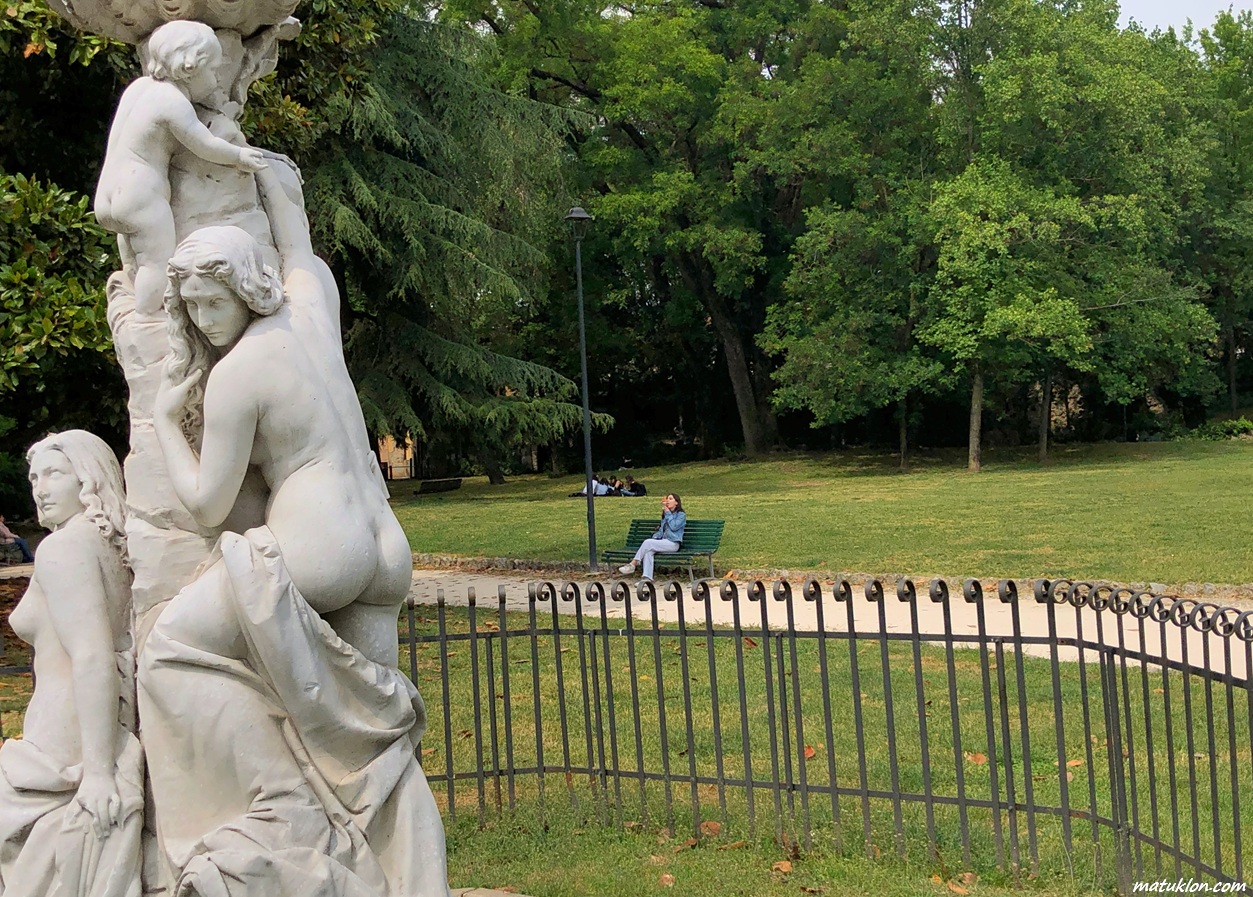
A much-needed public park in a city short of green spaces. It’s right in the centre, in Piazza Roma, a stone’s throw from the main landmarks. Quite loved by the residents, judging from the amount of people strolling about with dogs, relaxing on benches and lounging on the clean lawns.
There are quite a few statues dotted around, but don’t expect to see the park’s patron, John Paul II. Instead, you’ll find composers Claudio Monteverdi and Amilcare Ponchielli. There’s also yet another tribute to Antonio Stradivari whose tomb used to lay there, in a long-demolished church. But my favourite piece is Giovanni Seleroni’s fountain with the naiads.

Chiesa di Sant’Agata
I’m not really interested in churches, but they’re the place to be when the heat outside gets too much! The patron of this Catholic church is Agatha of Sicily, known in Italy as Sant’Agata. It is one of the oldest churches in Cremona, although very little, if anything at all, remains of the original 11th-century form.

Chiesa di San Luca
If there’s one thing that isn’t missing in Italian cities, it’s the churches! You can always be sure to stumble upon some chiesa around the corner. A short walk up the street from Church of Saint Agatha, there is one dedicated to Luke the Evangelist (San Luca). It was completed in 1272 and captivates with its rough, brick exterior.

Other attractions
Museo Ala Ponzone – a public museum and art gallery housed in the 16th-century Palazzo Affaitati
Teatro Amilcare Ponchielli – an 18th-century theatre, showing primarily opera
Romanian Orthodox Church (Chiesa Ortodossa Romena) – a small church I walked past on my way to Teatro Infinity 1
River Po – popular for cruises and walks along its green banks
 Cultural centre A.D.A.F.A.
Sources
Curious Cremona, Italy: a city of vintage violins, mustard fruit and surprises. Dan Flying Solo
Galleria 25 Aprile. Comune di Cremona
Giardini di piazza Roma: quando le Naiadi avevano l’acqua ed erano “libere”. Cremona Sera
48 Hours in Cremona. Italy Travel and Life
Consacrata la chiesa ortodossa romena di Via Litta. CR1
 Palazzo Raimondi
